
EDUCATION
Burslem College of Art, Royal College of Art, Royal Academy Schools
EXHIBITIONS
Sculpture: Royal Academy, Society of Portrait Sculptors, Royal Society of British Artists
Painting: Royal Institute of Oil Painters, Royal Society of Portrait Painters, Society of Equestrian Artists, New English Art Club, Royal Society of British Artists
MEMBERSHIPS
Royal Society of British Artists, Society of Equestrian Artists
BIOGRAPHY
Gordon Thomas Hulson was born in Stoke-on-Trent on 15thMarch 1937, the eldest of four children. He grew up in Burslem, showing artistic talent at a young age when his classmates asked him at 5 years old to draw aeroplanes for them in perspective. He benefited in his secondary education from gaining a place at the Staffordshire Junior Art School at Portland House, Burslem, where his 1951 report records that he was top of the class.
At the age of 15 Hulson started work in the modelling department at Wedgwood’s while simultaneously attending Burslem College of Art as a part-time day-release industrial student. In 1956 he gained a place at the Royal College of Art to study Ceramic Modelling on a Wedgwood Scholarship.

He was always supremely confident in his ability to undertake practical tasks, moulding and casting all his own sculpture. In his first year he completed an extraordinary feat of art and craftsmanship for his study from the antique. After modelling a copy of a Palissy dish, featuring a classical scene in relief, he succeeded in making a perfect one piece mould from which he cast it, although everyone had advised that this was impossible.
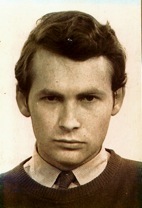
In 1958 he was assigned to make the life size model in clay of a Unicorn, designed by Arnold Machin RA for the British Pavilion at the Brussels Exhibition. By this time he was spending increasing amounts of his time on sculpture and was encouraged by both Arnold Machin and John Skeaping, who was Professor of Sculpture, to apply for a transfer to the Sculpture Department. Unfortunately, this was refused, which resulted in his degree being withheld simply because of the disproportionate amount of sculpture in his final show.

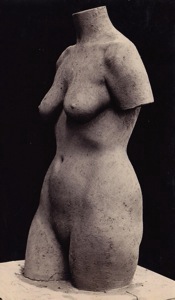
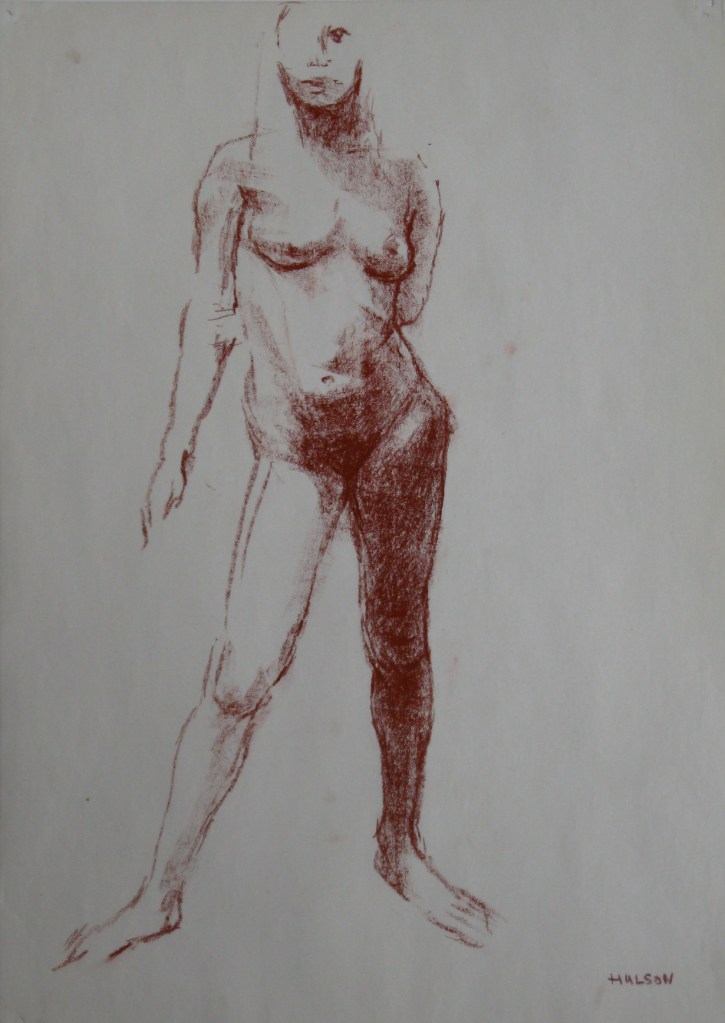
In 1960 he showed his work at the Society of Portrait Sculptors as well as at the Royal Academy Summer Exhibition, where his portrait of Helen was placed next to Epstein’s portrait of Princess Margaret. However, he was eager to continue his studies, so applied to study Sculpture and in 1961 was accepted at the Royal Academy Schools, where Arnold Machin was now Professor of Sculpture. Although he was not able to complete the course, he worked with great intensity there and the quality of his work in both Sculpture and Drawing was much admired, by Peter Greenham RA among others. Hulson had always believed passionately in the importance of drawing for an artist to reach a fundamental understanding of form and structure, and Life Drawing remained an inspiration to him throughout his life.


Marriage and fatherhood brought new responsibilities, so he utilised his outstanding skills to become one of the most sought after restorers of antique china in London. Nevertheless, he remained true to his principal vocation as a sculptor, as well as making a few exploratory abstract paintings.

Towards the end of the Seventies Hulson decided to change direction in favour of painting. He experimented with acrylics and oils, deciding quite quickly in favour of the latter and, typically, went to considerable lengths to research techniques. His first paintings were mostly portraits, but his range expanded to include landscape, with a focus on trees, still life, equestrian subjects and abstracts.

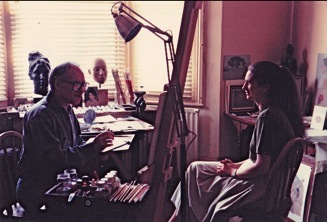
During this period up to the end of his life Hulson continued to draw, attending various Life Drawing classes and sometimes employing models in his studio. He also made a series of portrait paintings of friends and family. In 1984 his portrait of his daughter Brigid wearing a hat, shown at the Royal Society of Portrait Painters, won him a commission from BP to paint a portrait of the winner of the Miss BP competition.
He was always a man who did nothing by halves. He had a terrific sense of fun, to the delight of his children, Marc and Brigid, who were enthralled by his outlandish tales of the escapades of their teddy bears. He loved to entertain friends, when conversation, argument and wine flowed freely, and he was a superb dancer. He also loved an eclectic variety of music, ranging from Talking Heads to Jazz and J.S.Bach. Hulson was a perfectionist and his own most severe critic, so that he chose relatively rarely to show his work in public. In a sense Art was, for him, almost a form of meditation, a very personal activity, a study of the nature of things.
Gordon Hulson died on 18th June 1999 following a heart operation.
 Gordon Hulson RBA